Research article
Professional Ethics in Initial Teacher Education: Impact and Challenges in Higher Education
La ética profesional en la formación inicial del profesorado: impacto y desafíos en la educación superior
María José Latorre-Medina1* (ORCID), Purificación Pérez-García1 (ORCID)
1Universidad de Granada
*Corresponding author: mjlator@ugr.es
Received: 30/08/2026 - Accepted: 22/11/2026 - Published: 24/11/2026
DOI: https://doi.org/10.18634/sophiaj.22v.1i.1704
How to cite: Latorre-Medina, M. J., & Pérez-García, P. (2026). Professional Ethics in Initial Teacher Education: Impact and Challenges in Higher Education. Sophia, 22(1). https://revistas.ugca.edu.co/index.php/sophia/article/view/1704
Funding: This work was supported by the Vice-Rectorate for Research and Transfer of the University of Granada, Spain, under Grant [Reference PP2025.EI-14]; and Grant UCE-PP2025-02-26-02 funded by the RESET Scientific Unit of Excellence at the University Campus of Ceuta, University of Granada, Spain.
Disclosure statement: The authors declare that there are no conflicts of interest regarding the research, authorship or publication of this article. They also state that no generative AI was used in the preparation of the manuscript.
This work is licensed under a Creative Commons Attribution 4.0 International License. Sophia. Copyright 2026. Universidad La Gran Colombia.
Abstract
Professional ethics is essential to initial teacher education, yet its integration into student teachers’ professional identity remains challenging. This qualitative study examines changes in Early Childhood Education student teachers’ conceptions of teaching following a 12-week ethics intervention at a Spanish university. The programme incorporated ethical dilemmas, case studies, problem-solving and critical reflection. Thematic analysis of pre- and post-intervention data revealed continuity and partial reconfiguration in participants’ conceptions. Vocation remained central, while empathy, care, patience and ethical commitment gained prominence. Participants also increasingly recognised the importance of pedagogical preparation, reflective practice and lifelong professional development. Despite these advances, references to diversity and educational inclusion became less prominent, and the extent of change varied across participants. These findings highlight the need to integrate ethical reflection systematically and rigorously into initial teacher education.
Keywords: educational intervention, professional ethics, student teachers, teacher education, teaching profession.
Resumen
La ética profesional constituye un elemento fundamental en la formación inicial de docentes, aunque su integración en la identidad profesional de los futuros maestros continúa siendo un reto. Este estudio cualitativo analiza la evolución de las concepciones sobre la docencia de futuros maestros de Educación Infantil tras participar en un programa de intervención sobre ética profesional, desarrollado a lo largo de doce semanas en una universidad española. El programa incluyó dilemas éticos, análisis de casos, resolución de problemas y procesos de reflexión crítica. El análisis temático de los datos recabados antes y después de la intervención puso de manifiesto tanto la continuidad como una reconfiguración parcial de las concepciones de los participantes. La vocación mantuvo su papel central, mientras que la empatía, el cuidado, la paciencia y el compromiso ético adquirieron una mayor relevancia. Asimismo, los participantes reconocieron progresivamente la importancia de la formación pedagógica, la práctica reflexiva y el desarrollo profesional a lo largo de la carrera. Pese a estos avances, las menciones a la diversidad e inclusión educativa pasaron a un segundo plano y no todos los participantes experimentaron la misma evolución. Estos resultados acentúan la necesidad e importancia de incorporar de manera sistemática y rigurosa la reflexión ética durante la formación inicial del profesorado.
Palabras clave: intervención educativa, ética profesional, futuros docentes, formación del profesorado, profesión docente.
Introduction
Identifying the most relevant research currently being conducted on initial teacher education is no easy task. Our reviews of the scientific literature on different aspects of initial teacher education reveal the enormous volume of data that educational research has generated in this field. A brief look at the handbooks published periodically, articles appearing in some of the most prestigious journals, and the impressive number of books published worldwide each year gives an indication of the importance and scale of scholarly output in this area of inquiry. It is not our purpose here to set out the main thematic areas addressed by this research. Rather, we wish to point out that most studies in this field have focused, and continue to focus, on the knowledge, skills, and other dispositions required for teaching. The work of Day (2005), De Vicente (2006), Darling-Hammond (2012) and Perrenoud (2004), among others, provides key reference points for what has been written and investigated to date.
Knowledge of the most promising approaches to teacher education (Boon, 2011; Day, 2018; Vaello, 2009) provides the foundation for our research projects, which focus on professional ethics in teaching. More specifically, within the line of inquiry we have pursued in recent years, we seek to understand how student teachers address the challenge of determining whether they are sufficiently prepared, both attitudinally and in terms of their skills, to assume an active role and demonstrate ethical commitment and leadership in their future profession. We start from the premise that student teachers must not only know how to practise their profession, but also want to practise it appropriately, in accordance with the ethics of the profession, and, as Escudero (2006) explains, be willing to do so. This author argues that the teacher education curriculum should integrate theoretical and practical content to develop the ideas and capacities needed to address ethical dilemmas, justify decisions and know how to act. But are student teachers prepared for this by higher education institutions?
A commitment to holistic education at university
There is a conception of a high-quality university as one that is research-intensive and prepares students well for entry into the labour market. These two indicators are important, but they cannot be the only ones. Such a conception overlooks one of the principal dimensions of the contemporary university’s mission. The university is a space for learning and science, and for the creation and transmission of knowledge, but it must also provide holistic education for those who study there (Martínez, 2026).
In the university context, ethical education does not merely complement academic learning; it is fundamental to students’ holistic development. Higher education therefore faces the challenge of not only transmitting knowledge but also fostering critical skills and robust values that prepare students to resolve moral dilemmas in their professional and personal lives. Higher education undoubtedly plays a crucial role in the ethical and moral development of students, who are the professionals of the future.
The ethical dimension of university education
The lack of references to research and research articles on ethics and/or values education in universities in the bibliographic studies reviewed on this topic leads us to argue for greater attention to, and a more systematic and in-depth approach to, the ethical dimension of university education. We advocate a university that, among other things, provides a space for deep learning and helps future graduates become ethically competent professionals.
In this regard, Martínez (2026) proposes three perspectives for addressing ethical competences at university. The first focuses on the competences required from a deontological perspective and in the exercise of a profession. The second emphasises ethical and civic education, that is, how universities can contribute to educating excellent citizens and professionals. The third concerns the conditions university teachers should create so that classrooms and faculties become spaces for ethical learning and coexistence. The first two perspectives are important, but we wish to highlight the third: university teachers’ ethical commitment to students’ holistic development. What are our ethical commitments as university teachers? The answer seems clear: to help build a more inclusive and dignified society for all by educating future professionals who are ethically well prepared.
Unfortunately, the reality appears to be different. Not all universities or academic staff regard the development of students’ ethical responsibility as part of their role. There is a disconnect between two objectives that should, in principle, be integrated into university teaching (Cortina, 2013): preparing graduates to be technically competent professionals with a higher education qualification (“good professionals”), while also educating them as ethical people (“good people”).
Ethical competences are unquestionably not an added extra; they are a fundamental component of any university education that aspires to quality. We must therefore consider how to prepare students to become ethically competent (Buxarrais, 2026).
The present study
This article presents the most relevant findings from two research projects funded by the University of Granada, Spain. One was awarded funding through the University’s Research Plan by the Vice-Rectorate for Research and Knowledge Transfer (PP2025.EI-14); the other was approved by the Scientific Centre of Excellence (RESET, Spanish acronym) at the Ceuta University Campus (UCE-PP2025-02-26-02). Both projects are being conducted by members of the “Training, Development and Teaching Activity” Research Group (FYDAD, Spanish acronym), following the favourable opinion of the University of Granada Ethics Committee (No. 5518/CEIH/2026).
Both projects focus on initial teacher education, specifically on preparing ethical and professionally responsible teachers, in line with key recommendations in international reports (GENE, 2022; GUNI, 2024) and calls from the national and international academic and scientific education communities (Araujo et al., 2021; Boon, 2011; Buxarrais, 2026; Day, 2018; Dolev & Itzkovich, 2021; Martínez, 2026; Royo, 2017; Vaello, 2009). The FYDAD Group is working to foster ethical leadership among student teachers studying at the Faculty of Education, Economy, and Technology of Ceuta (University of Granada), so that they can practise their future profession professionally, in keeping with the principles discussed by Darling-Hammond and Bransford (2005), Darling-Hammond and Hyler (2020), and Day (2018). This entails assuming (and educating and preparing them to assume) not only technical and legal responsibilities, but also moral and ethical ones.
Broadly speaking, both projects adopt a dual methodological approach, combining methods in keeping with recommendations for educational research (Creswell & Guetterman, 2019; Johnson & Onwuegbuzie, 2004). More specifically, the research activity in both studies is organised into three phases: (a) Phase I, Diagnosis: the ethical profile and leadership of student teachers; (b) Phase II, Intervention: the design and implementation of a professional ethics intervention for student teachers undertaking their practicum; and (c) Phase III, Evaluation: analysis of the impact of the intervention, designed specifically for this purpose, on the attitudes and conceptions of student teachers who completed the programme during their practicum.
Within this third phase, members of the research team have qualitatively analysed the impact of the intervention on participants’ perceptions and conceptions of teaching, what it means to be a teacher, and the practice of the profession. This study presents some of the scientific evidence obtained to date from Early Childhood Education student teachers.
Purpose of the study
The main purpose of this study was to examine how student teachers conceptualise the teaching profession and to identify changes in their perceptions and conceptions before and after taking part in an intervention programme on professional ethics in teaching. The aim was to identify continuities, shifts, advances and/or progress, as well as possible new dimensions in how they understand teaching, the role of teachers, their attitudinal commitment and their pedagogical responsibility.
More specifically, the study was guided by the following research questions:
- RQ1. What conceptions of the teaching profession do student teachers express before participating in the intervention programme on teacher ethics?
- RQ2. What continuities and/or changes can be observed in their educational conceptions after participating in the intervention programme on teacher ethics?
- RQ3. How are these changes, advances and/or developments manifested? Which perceptions of the teaching profession are enriched?
Methodology
To understand and analyse the transformations experienced by student teachers after participating in an intervention programme on teacher ethics, this study adopted a qualitative research approach (Stake, 2010), which allows for a holistic and contextualised understanding of personal and academic growth and development.
The study drew on qualitative data generated through work produced by the student teachers who participated in the intervention, including analyses and reflections. These materials were used to gain a deeper understanding of their experiences, perceptions and attitudes towards teaching.
All participants provided informed consent, and the study received ethical approval from the University of Granada Ethics Committee (Reference No. 5518/CEIH/2026).
Population and sample
Across the two projects, the target population comprised, first, first-, second- and third-year students with no practicum experience enrolled in the Early Childhood Education and Primary Education degrees offered by the Faculty of Education, Economy, and Technology at the Ceuta University Campus of the University of Granada. Second, it included fourth-year students with practicum experience, having completed both practicum placements required by the education degrees offered at the Ceuta Campus. The total population comprised 352 student teachers (see Table 1).
Taking advantage of access to the student population, we used non-probability, non-random, convenience (incidental) sampling. Chiu (2024), for example, argues that convenience sampling is a valid methodological alternative in educational research where accessibility and participants’ willingness to take part are decisive factors. This approach made it possible to recruit a substantial sample of 292 student teachers (see Table 1).
Table 1
Study Population and Sample
| Degree/year | Primary Education: population | Primary Education: sample | Early Childhood Education: population | Early Childhood Education: sample |
|---|---|---|---|---|
| Year 1 | 71 | 53 | 14 | 12 |
| Year 2 | 69 | 56 | 21 | 21 |
| Year 3 | 53 | 45 | 36 | 36 |
| Year 4 | 52 | 46 | 36 | 23* |
| Total | 245 | 200 respondents | 107 | 92 respondents |
Note. Academic year 2025-2026.
*These students completed the intervention programme.
The participants specifically involved in this study were the 36 fourth-year students enrolled in Practicum II in the Early Childhood Education degree during the 2025-2026 academic year. Through informed consent, they were told of the study’s purpose and that participation was entirely voluntary and anonymous. A total of 23 students attended all working sessions and completed the teacher ethics intervention programme implemented during this practicum period.
Data collection instruments
Data were collected through the written work produced by participants during the professional ethics intervention programme, designed specifically for the two projects, based on a systematic literature review and previous training experiences in this area (Pérez-García, 2026). The programme content addresses issues relating to professional ethics in teaching and incorporates the dimensions proposed by Dolev and Itzkovich (2021), using moral dilemmas, case studies and problem-solving activities (Bolívar, 2017; Yi, 2015). Developing awareness, taking a position and reflecting on decisions formed the programme’s guiding thread. The main aim of the intervention was to foster analysis, critical thinking, moral awareness, teachers’ professional positioning and critical reflection on the decisions made by participating student teachers. According to Asensio and Ruiz de Miguel (2017), students’ beliefs about teaching and the teacher’s role, which they bring with them when they enter education degrees, do not change significantly during initial teacher education unless they are explicitly addressed. This makes it necessary and urgent to engage with these beliefs.
Procedure
To date, the teacher ethics intervention programme has been implemented in Practicum II, a fourth-year course in the Early Childhood Education degree. According to the 2025-2026 academic calendar, this training period ran from 23 February to 29 May 2026. Alongside students’ learning experiences in external placement schools, the intervention was delivered through weekly one-hour working sessions over the 12 weeks of Practicum II. In total, the 23 participants attended 12 sessions held at the faculty. Across these sessions, student teachers moved from individual positioning and engagement with their own ethical conceptions (Sessions 1, 3, 4, 5, 8 and 10), to considering others’ perspectives by reflecting on peers, the educational institution and society (Sessions 2, 6, 7 and 9), and finally to articulating a personal vision of themselves as future teaching professionals (Session 11). Session 12 provided an opportunity for closure, reflection and overall evaluation.
Data analysis
The data were analysed using thematic analysis, a method that enables researchers to identify and interpret key patterns in qualitative data (Braun & Clarke, 2022; Díaz, 2018). Initial coding was conducted on students’ work (analyses, reflections and other materials) produced during the first and final sessions of the intervention programme. The aim was to compare students’ accounts and explore their views (including developments, progress and changes) regarding teacher ethics, commitment and pedagogical responsibility, as expressed in their initial and final self-projections as teaching professionals. In both sessions, students responded to the prompt, “For me, being a teacher is…”. Their answers were brief and generally consisted of words or short expressions; consequently, their analysis and interpretation needed to consider both their manifest meaning and the conceptual relationships that could be established.
This approach made it possible to capture notable similarities and emerging patterns. Following the initial coding, similar codes were consolidated into broader categories to construct the themes presented in the findings and discussion section. The analysis identified eight central or emerging categories relating to the teaching profession, all derived from the evidence obtained in this study: (1) professional vocation and motivation; (2) ethics, values and professional responsibility; (3) empathy, care and affectivity; (4) teaching and support; (5) inclusion, diversity and adaptation; (6) knowledge, training and professional development; (7) communication, coexistence and collaboration; and (8) personal qualities and dispositions for teaching.
More specifically, an Excel coding matrix was first developed. It included the original expressions (anonymous identifier, time point [before or after the intervention] and assigned category), codes, categories, descriptive frequencies (number of mentions and number of participants per category before and after the intervention), participant-level comparisons (presence and number of mentions of each category for each participant at both time points), and the category manual (operational definitions and inclusion and exclusion criteria).
The analysis focused on the meaning conveyed by each word or concept in relation to the teaching profession. Each distinct concept was treated as a potential unit of analysis and assigned to a category according to its meaning. Where a response contained concepts associated with different dimensions, each concept was considered separately. Explicit operational criteria were used to address ambiguous expressions, overlapping categories and repeated concepts, ensuring consistent application of the coding rules at both time points.
Responses collected before and after the programme were examined in relation to one another. The comparison aimed to identify the categories expressed at each time point, the concepts that were retained or newly expressed, and the differences between participants’ responses. Given the paired nature of the data, the analysis distinguished between changes in the overall distribution of categories and changes observed in individual participants’ responses.
To strengthen the transparency and dependability of the analysis, the coding framework was documented through operational definitions and inclusion and exclusion criteria (see Table 2), and coded responses were checked against the original data. Revisions to category definitions or coding decisions were recorded. Illustrative anonymised examples from the original responses were used to demonstrate the relationship between the data and the interpretation.
Table 2
Category Manual
| Category | Operational definition | Inclusion criteria | Exclusion criteria | Illustrative anonymised examples |
|---|---|---|---|---|
| C1. Professional vocation and motivation | Expressions presenting teaching as a vocation, aspiration, interest or activity that generates satisfaction, enthusiasm or personal motivation. | Explicit references to a teaching vocation; interest in teaching and motivation towards the profession; satisfaction, passion or enthusiasm associated with being a teacher. | Professional duties or ethical principles (C2); affection directed towards pupils (C3). | Vocation; vocational; motivation; passion; enthusiasm; satisfaction. |
| C2. Ethics, values and professional responsibility | Expressions concerning teachers’ duties, responsibility for their conduct, ethical principles and values guiding professional behaviour. | Explicit references to ethics, responsibility and ethical commitment; values and respect presented as principles of professional conduct; being responsible or serving as a moral role model. | Commitment used only to mean motivation or dedication without an explicit ethical meaning; respect or affection referring exclusively to interpersonal relationships (C3 or C7, depending on context). | Responsibility; ethics; ethical commitment; values; justice; respect; decency. |
| C3. Empathy, care and affectivity | Expressions describing sensitivity to pupils, emotional care, interpersonal understanding, listening and patience in educational relationships. | Understanding pupils’ needs or experiences; listening, empathy, patience and sensitivity; affection, tenderness, love or care for students. | Listening mainly as a general communication skill (C7); attention to differences and specific educational needs (C5 when the meaning is inclusive). | Empathy; patience; affection; tenderness; care; understanding; ability to listen. |
| C4. Teaching and support | Expressions presenting teachers as responsible for teaching, guiding, supporting and promoting pupils’ learning and development. | Teaching and educating; guiding and supporting; promoting holistic development, childhood and learning; inspiring, motivating or helping pupils develop. | Teachers’ own professional learning (C6); specific adaptation to pupil diversity (C5). | Teaching; educating; guidance; support; holistic development; learning; inspiration. |
| C5. Inclusion, diversity and adaptation | Expressions referring to recognising pupil diversity, promoting inclusion and adapting educational responses to pupils’ needs and characteristics. | Inclusion, diversity and adaptation to pupils; attention to different learning paces or needs; autonomy, integration or participation explicitly linked to educational provision. | Flexibility or adaptability as general personal qualities (C8); generic support not referring to diverse needs (C4). | Inclusion; diversity; adapting to pupils; learning paces; adaptability; autonomy. |
| C6. Knowledge, training and professional development | Expressions concerning knowledge, pedagogical and subject-specific competences, reflection on practice and teachers’ continuing learning. | Subject knowledge and methodologies; continuing professional development; planning, practice, methodological creativity and pedagogical innovation when linked to teaching. | Creativity as a general personal trait (C8); pupils’ learning (C4). | Continuing professional development; knowledge; subject mastery; methodology; planning; practice; innovation; learning. |
| C7. Communication, coexistence and collaboration | Expressions concerning communication skills and collaborative relationships that support coexistence and interaction in educational settings. | Communication and active listening; coexistence, teamwork and collaboration; relationships with families and participation in the educational community. | Listening primarily associated with emotional understanding of pupils (C3); guiding or supporting learning (C4). | Communication skills; good communication; active listening; coexistence; teamwork; collaboration with families. |
| C8. Personal qualities and dispositions for teaching | General personal traits or capacities considered relevant to teaching that do not fit more precisely into the preceding categories. | Creativity, flexibility and resilience; self-control, humility, perseverance and organisation; leadership, autonomy and general capacity for self-criticism. | Specific pedagogical competences (C6); patience and empathy in educational relationships (C3); adaptability explicitly related to pupil diversity (C5). | Creativity; flexibility; resilience; self-control; perseverance; organisation; humility; leadership. |
Note. Developed by the authors.
Finally, to ensure the trustworthiness of the qualitative analysis, the research team conducted an intersubjective validation process and reached substantial agreement on the analysis and interpretation of the data (Martínez Miguélez, 2006).
Findings and discussion
The comparison between the two time points, before and after the intervention, proved particularly informative. A brief examination of Table 3 shows the impact of the intervention on student teachers’ educational conceptions. Specifically, it helps us understand how student teachers’ professional identities are configured, which qualities they regard as essential to teaching, and the extent to which their conceptions broaden or change after participating in the teacher ethics programme. The evidence indicates that, following the training, student teachers adopted a more complex view of teaching as a professional, educational and moral activity (Latorre & Borja, 2026).
Table 3
Number of Mentions by Category Before and After the Intervention
| *Category | Pre-intervention mentions | Post-intervention mentions |
|---|---|---|
| C1. Vocation and motivation | 29 | 40 |
| C2. Ethics, values and professional responsibility | 40 | 47 |
| C3. Empathy, care and affectivity | 52 | 74 |
| C4. Teaching and support | 62 | 31 |
| C5. Inclusion and diversity | 8 | 5 |
| C6. Professional learning and development | 26 | 19 |
| C7. Communication and collaboration | 12 | 9 |
| C8. Personal qualities | 21 | 25 |
Note. Developed by the authors.
*The titles of some categories are presented in abbreviated form.
It is important to clarify that the main task was not simply to identify which expressions appeared before and after the intervention, but to analyse the conception of the teaching profession conveyed by each set of words, which dimensions became more prominent, and what changes these suggest in understandings of educational responsibility, relationships with pupils and teachers’ ethical commitment, among other issues. The findings are presented below.
Analysis of the collective trajectory: from personal qualities to an understanding of the profession
Vocation: from personal disposition to professional identity
Vocation is one of the most persistent elements across the responses. It was already prominent before the intervention, indicating that student teachers enter teacher education with an existing representation of teaching as a profession associated with personal inclination, an interest in childhood or a desire to teach. After the intervention, vocation neither disappears nor is displaced by ethical discourse. On the contrary, it remains central. In some cases, it is expressed in more explicitly professional terms, as when participants refer to a “teaching vocation” or “ethical commitment”.
This continuity is important because it suggests that initial teacher education does not necessarily replace prior conceptions but may give them new meanings. Vocation remains important, while increasingly coexisting with more explicit references to responsibility, training, empathy and commitment.
Nevertheless, two conceptions of vocation should be distinguished: (a) a predominantly personal conception, associated with liking, inclination or the desire to work as a teacher; and (b) a professional conception, in which vocation is linked to responsibility towards pupils, pedagogical preparation and commitment to educational work.
The material analysed provides indications of this second orientation, although it does not justify claiming that all participants made this transition. The persistence of vocation may be interpreted as identity continuity, while its association with other qualities suggests that its meaning may have broadened.
Empathy and patience: the centrality of the educational relationship
One of the most significant changes associated with the teacher ethics intervention concerns the importance attached to empathy and patience. Both were present before the intervention but became particularly prominent afterwards.
Empathy appears as a quality running through the responses of many participants. In some cases, it remains present; in others, it moves to the forefront of student teachers’ accounts. For example, one student teacher (ST_19) initially identified “teaching” and “understanding”, whereas after the intervention she highlighted “empathy”, “affection” and “patience”. This change suggests a representation in which teaching is accompanied by more explicit recognition of the dispositions needed to understand and respond to pupils.
Patience follows a similar pattern. It appears in several responses before the intervention but is mentioned by many more student teachers afterwards, alongside empathy, understanding and listening.
This finding raises an important issue: teaching appears to be represented increasingly not only as the transmission of knowledge but also as an interpersonal relationship that requires understanding pupils, respecting their pace and responding to their needs.
Patience here means more than a temperamental trait. In education, it can be associated with accepting that learning processes differ, that error is part of development, and that pupils’ difficulties require appropriately tailored pedagogical responses.
Empathy can also be understood as an ethical disposition: recognising students as people with their own needs, circumstances, pace and potential. From this perspective, empathy is not limited to emotionally understanding another person; it can also guide teachers’ decisions.
For example, one student teacher (ST_3) initially mentioned empathy, listening, adapting to pupils and communication skills. Her later statements included responsibility, values, interest, support, planning and creativity, among other qualities. This development does not represent the replacement of a relational dimension by a pedagogical one; rather, it broadens the conception by connecting attention to pupils with the organisation of teaching.
From commitment and responsibility to a more explicit ethical conception
This dimension is particularly relevant given the nature of the training programme.
Before the intervention, responsibility and commitment were already among the qualities mentioned. It would therefore be inaccurate to claim that participants were initially unaware of the moral dimension of the profession. What merits attention is how these notions are retained, reformulated or accompanied by more explicit references to ethics.
At the outset, responsibility may be interpreted as a general expectation of good teaching: fulfilling duties, teaching appropriately, caring for pupils and working conscientiously. Commitment, in turn, may express personal involvement and a willingness to take on educational responsibilities.
After the intervention, some participants used expressions that allow for a more direct ethical interpretation: “ethical commitment” appeared in the responses of several student teachers (ST_6 and ST_10), while “ethics” appeared in the contributions of others (ST_12, ST_17 and ST_18). These expressions are significant because they make visible a dimension that is not necessarily explicit when participants refer only to vocation, affection or responsibility.
Ethics can be understood as the framework through which professional decisions are examined, educational actions justified and their consequences for those involved assessed. It is therefore not merely a matter of acting with good intentions: it also requires scrutiny of which decisions are fair, how pupils are treated and what responsibilities accompany the exercise of teacher authority.
The relationship between responsibility and commitment also shows an interesting development. Responsibility appears at both time points, whereas commitment becomes more prominent in the later responses. This supports the hypothesis that some student teachers came to express a conception of the profession more closely associated with active involvement than with the mere fulfilment of duties.
The distinction matters: it is one thing to believe that teachers should be responsible for their duties, and another to understand that their work entails sustained commitment to pupils’ learning, well-being and development.
In any case, a cautious interpretation of the evidence obtained is that the ethical dimension of teaching became more explicit in some cases, while other participants shifted their priorities towards qualities such as empathy, patience, creativity or motivation.
Broadening professionalism: continuing development, knowledge and reflection
Another analytical strand concerns the understanding of teaching as a profession requiring preparation, updating and the capacity for review.
Before the intervention, some responses referred to knowledge, skills, adapting to pupils, communication or organisation. The professional and pedagogical dimension was therefore present from the outset, although it coexisted with references to vocation, responsibility and personal qualities.
After the intervention, expressions such as “continuing professional development”, “knowledge”, “planning”, “methodology”, “self-criticism”, “reflection”, “learning” and “creativity” appeared.
The presence of continuing professional development is particularly significant. For example, one student teacher (ST_8) included “continuing professional development” and “creativity” in her later contributions. The impact of the intervention on this individual trajectory is reflected in an expanded understanding of the educational purpose, as well as in the fact that ethics and continuing professional learning become visible.
Other student teachers referred to continuing professional development as a professional quality, rather than viewing teaching as a profession dependent exclusively on teachers’ personal characteristics.
This shift suggests movement away from an image of teachers as people who possess certain qualities towards a conception of teachers as professionals who need to develop, review and update their competences. Continuing professional development entails recognising that initial preparation cannot resolve every educational situation. Teaching requires learning from experience, reviewing decisions, adapting strategies and responding to changing circumstances.
In this regard, reflection and self-criticism have not yet attained the level of importance they warrant. The ability to acknowledge errors, analyse one’s own actions and reconsider decisions constitutes an essential component of professional responsibility. Teachers must not only act but also question why they act in a particular way and what effects their actions produce.
The material analysed contains only a few references, all of which predate the intervention, to the “skill to engage in self-criticism” (ST_2), as well as to continuous “learning” (ST_21). Although these expressions are not frequent, they indicate that the teaching profession is also understood from the perspective of professional improvement and development.
Creativity deserves further consideration. Its later appearance may be related to the idea that teachers need to design educational responses, adapt resources and find alternatives in diverse situations. The point is not simply to be a creative person, but to use creativity to improve learning opportunities.
From teaching to supporting, understanding and promoting holistic development
Initial responses included direct references to “teaching”, “educating”, “children”, “childhood” and “knowing”. These expressions reflect a view of teaching linked to educational activity and its recipients. Following the intervention, student teachers’ work included expressions such as “supporting”, “guiding”, “helping”, “inspiring”, “understanding” and “making children happy to learn”. This development provides insight into how the purpose of teaching is represented.
In a conception focused primarily on teaching, attention is directed towards the teacher’s activity and what the teacher must transmit. When support, guidance and help are included, the focus broadens to encompass students’ learning processes and the conditions they need to learn and develop.
Teaching and supporting are not opposing activities; they are complementary. The difference lies in understanding teaching as a relational activity, responsive to pupils’ needs and oriented towards their development. The case of one student teacher (ST_7) is illustrative. Before the intervention, she mentioned vocation, creativity, confidence, monitoring and holistic development. Afterwards, she included knowledge, communication, empathy, vocation, motivation, organisation, inspiration and commitment. Her later response combines professional, relational and motivational dimensions, suggesting a more integrated view of teaching. Another student teacher’s statement (ST_8), “Making children happy to learn”, is also noteworthy. It brings well-being and learning together rather than reducing the teacher’s role to either one alone.
From an ethical perspective, supporting pupils means recognising them as active agents in their own development. Teachers do not merely transmit content; they help create the conditions in which students can learn, become more autonomous and develop their capacities.
Inclusion, diversity and justice: a dimension that still needs to be consolidated
Inclusion is particularly relevant to the analysis of teacher ethics because it concerns recognising differences and the duty to ensure that all pupils can participate and learn.
The material contains explicit references to “inclusion”, “diversity”, “integration” and adaptation to pupils. However, these terms are not distributed evenly across participants, nor do they show a clear increase across the later responses. It would therefore be excessive to claim that ethics education produced a general shift towards an inclusive conception of teaching. It can, however, be noted that some student teachers incorporated elements consistent with such an orientation, including adapting to pupils’ learning pace, understanding, flexibility, respect and listening. These qualities may support inclusive practice, although they do not in themselves amount to an explicit understanding of inclusion.
This distinction is important. Empathy involves trying to understand another person; inclusion also requires reviewing practices, removing barriers and ensuring opportunities for participation and learning. Likewise, respecting differences does not necessarily entail recognising how social, personal or educational conditions can generate inequalities.
The affective dimension: affection, love and sensitivity
Affection and love for pupils form part of both the initial and later representations of teaching. This indicates that student teachers attach importance to the affective dimension of educational work. After the intervention, references to affection remained present and were combined with empathy, understanding, support and patience. This continuity suggests that ethics education does not eliminate an affective view of the profession; rather, it allows that dimension to be considered alongside other professional demands.
Affection can foster trust, security and positive educational relationships. However, a professional conception of teacher ethics cannot rest solely on affection or goodwill. It also requires principles of justice, respect for pupils’ autonomy, responsibility and consistency in practice. The significance of these responses therefore lies in the possibility of integrating affective sensitivity into a broader conception of professionalism: a teacher who is approachable but also well prepared; understanding but able to set fair boundaries; emotionally engaged but aware of their responsibilities.
This integration is one of the most relevant findings, although more developed responses would be needed to establish how participants understand the limits and professional implications of affective closeness.
Analysis of individual trajectories: continuity, broadening and change
The overall analysis identifies trends, but examining individual transitions between categories (including continuity, addition, disappearance and reformulation) is essential to understanding that change is not homogeneous. What image of teaching and of the teaching professional do participants project? Table 4 shows different trajectories: student teachers who retain their initial priorities, those who broaden their conception of teaching, and others who introduce more explicit references to the ethical dimension of the profession. The following cases are particularly illustrative.
Table 4
Impact of the Intervention on Selected Individual Trajectories
| Student teacher | Before the intervention | After the intervention | Evidence of change |
|---|---|---|---|
| ST_1 | Commitment, vocation, responsibility, influence, resilience | Vocation, patience, empathy, responsibility, commitment, guidance, respect, learning, leadership | Commitment remains central, while relational qualities and pupil-guidance functions are added. |
| ST_2 | Personality, knowledge, skills, self-acceptance, mediation, autonomy, commitment and self-criticism | Empathy, responsibility, adapting to pupils, communication, patience, motivation, vocation and respect | An initial conception centred on characteristics and abilities becomes more clearly organised around educational relationships. |
| ST_3 | Empathy, listening, adaptation to pupils, communication, patience, vocation and values | Vocation, responsibility, interest, values, support, planning, adaptability and creativity | Relational dispositions are combined with planning and pedagogical adaptation skills. |
| ST_8 | Vocation, guidance, creativity, patience, responsibility, tenderness, love and respect | Making children happy to learn, vocation, affection, ethics, respect, empathy, continuing professional development and creativity | The educational purpose broadens, and ethics and continuing professional learning become visible. |
| ST_19 | Teaching, empathy, understanding, listening, leaving a mark, caring, participation, supporting and guiding | Empathy, ethics, affection, patience, understanding, guidance, leaving a mark, values and problem-solving | Teaching is accompanied by more explicit attention to ethics, care and the dispositions needed to relate to pupils. |
| ST_18 | Vocation, commitment, creativity, patience, dedication, perseverance, responsibility and affection | Vocation, empathy, affection, patience, commitment, care, ethics and learning | Vocational identity remains, while relational and ethical dimensions are reinforced. |
| ST_20 | Teaching, empathy, listening, empathising, supporting, participating and responsibility | Commitment, empathy, affection, trust and security, patience, responsibility, instilling values and being a source of support | The representation shifts towards an integrated view of educational relationships, emotional support and responsibility for transmitting values. |
| ST_21 | Vocation, life, opportunity, teaching, learning, inspiring, motivating and experiences | Commitment, responsibility, patience, active listening, affection, flexibility, vocation, empathy, enthusiasm and motivation | The representation broadens from identification with the profession to the qualities and responsibilities guiding teaching practice. |
Note. Developed by the authors.
The analysis of individual trajectories points to three patterns that should be distinguished:
Continuity and consolidation. Some student teachers retain essential elements of their initial representations, such as vocation, commitment or empathy. This continuity should not automatically be interpreted as an absence of learning, as it may indicate that the teacher ethics intervention reinforced prior convictions.
Broadening of the professional representation. In other cases, initial qualities are accompanied by new references to planning, continuing professional development, creativity, adaptation or reflection. The profession is then represented as an activity requiring both personal dispositions and competences that can be developed.
Making the ethical dimension explicit. Some responses directly incorporate terms such as “ethics” or “ethical commitment”, while others emphasise justice, respect, responsibility, care or the transmission of values. This suggests different ways of expressing the moral dimension of teaching: some more explicit and conceptual, others more closely tied to educational relationships and actions.
These patterns may coexist within the same participant. They are therefore best understood as dimensions of individual trajectories rather than as closed groups or hierarchical stages of professional development.
Conclusions
Considering the evidence presented, student teachers’ educational conceptions can be said to be dynamic: they retain prior elements, incorporate new reference points and establish different relationships between the personal qualities, professional competences and ethical responsibilities that define teaching (see Figures 1 and 2).
More specifically, analysis of the collective and individual trajectories of participating student teachers reveals a view of the teaching profession characterised by continuity in vocation and notable changes in the prominence of certain relational, professional and ethical qualities.
The most visible changes include increased references to empathy, patience, responsibility, creativity and motivation. These variations are consistent with greater attention to the relational dimension and to teachers’ active role in pupils’ learning and development. Explicit references to teacher ethics and continuing professional development also appear. Although they are not widespread, they indicate a conception of the profession that incorporates moral commitment and professional improvement. The image of a good teacher is no longer restricted to being patient, empathetic or vocationally motivated; it also includes knowing how to teach, wanting to teach, learning from practice and improving professionally.
Despite these positive findings, a decrease in explicit references to educational inclusion or collaboration with families was observed in other key categories examined. This evidence leads us to conclude that not all components of ethical identity were strengthened to the same extent following the intervention. Therefore, considerable work remains to be undertaken during teacher education, further reinforcing the value of interventions such as the one presented in this study.
A concise visual representation of these findings is provided in the figures below. The radar chart shows changes in the dimensions or categories analysed and makes it possible to identify transformations in perceptions and conceptions of the teaching profession (see Figure 1).
Figure 1
Impact of the teacher ethics intervention on perceptions and conceptions of the teaching profession
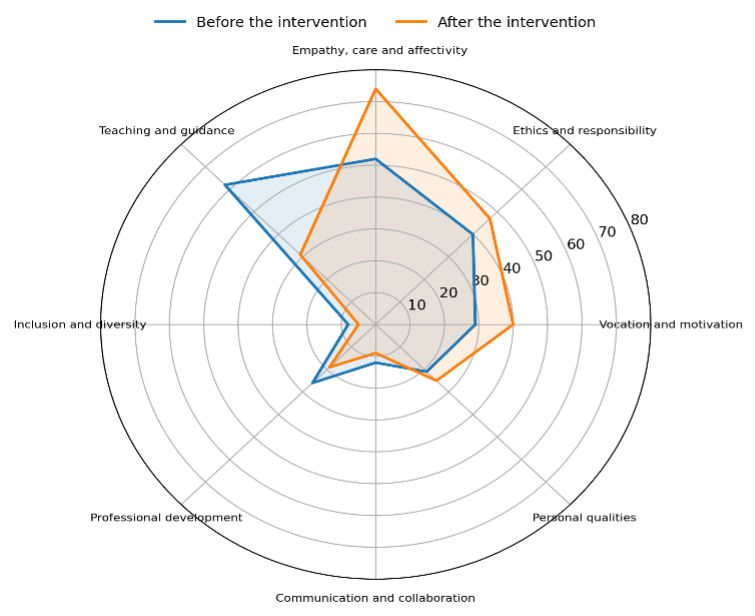
Note. Developed by the authors. The titles of some categories are presented in abbreviated form.
The grouped bar chart provides a more detailed view of these values. It shows the frequency of each category before and after the intervention, making changes in their distribution easier to discern (see Figure 2).
Figure 2
Impact of the teacher ethics intervention on student teachers’ educational conceptions
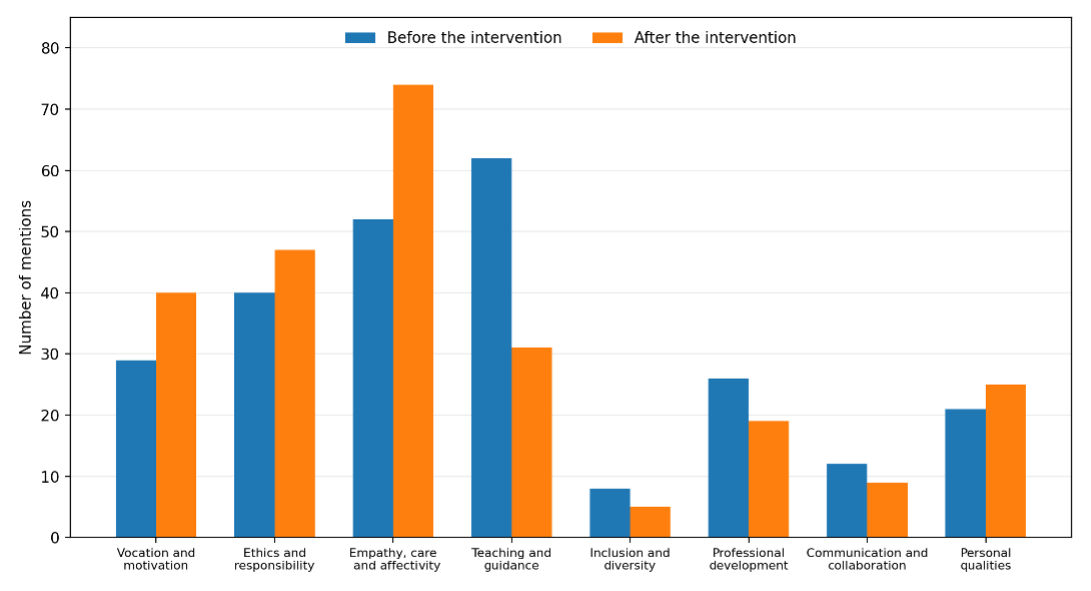
Note. Developed by the authors. The titles of some categories are presented in abbreviated form.
It is important to emphasise that the values shown in both figures represent frequencies of mentions at two time points, not direct measures of knowledge or competence levels.
In view of these findings, the prevailing representation of the teaching profession can be said to combine, to varying degrees, vocation, relational qualities, ethical commitment and professional competences. The most interesting outcome of the professional ethics training is not the disappearance of initial conceptions, but the emergence in some student teachers’ accounts of elements that had previously appeared more sporadically. Three broad developments can be identified:
From isolated vocation to responsible vocation. Personal inclination towards teaching remains, but is accompanied by references to commitment, ethics and professional responsibility.
From personal qualities to the educational relationship. Empathy, patience and listening become important as conditions for understanding pupils, supporting their learning and responding to their needs.
From teaching as a task to teaching as a complex profession. Continuing professional development, planning, creativity, reflection and adaptation represent teaching as an activity requiring preparation and ongoing improvement.
These developments should not be interpreted as a linear progression shared by all student teachers. The information available and analysed shows changes in educational conceptions but does not establish an identical developmental sequence for all participants.
Alongside this limitation, a methodological caveat is necessary. Although the main contribution of the analysis is to show that teaching is represented through a combination of personal, relational, pedagogical and ethical dimensions, the ethics training programme may have made some of these dimensions more visible and encouraged new associations between them. This interpretation nevertheless requires corroboration through further scientific evidence. To establish that conceptions have been fully internalised by student teachers, additional information would be needed from interviews, focus groups and observations of practical situations. Generating research outcomes and new knowledge in early childhood education requires studies that provide empirical evidence (Saracho, 2014). Since lexical changes should not be confused with established changes in conceptions, beliefs or practice, it would be advisable to examine during the practicum, for example, how student teachers justify their decisions and translate their conceptions into concrete educational situations. Previous research reinforces the centrality of the practicum as a key space for teacher ethics education during initial teacher education (Lluch et al., 2025; Villena-Martínez et al., 2026), as well as the importance of identifying the appropriate time and stage in teacher education for designing tasks that stimulate reflection in practice, critical and moral awareness, professional positioning and ethical decision-making.
Consequently, the most cautious conclusion is that the intervention is associated with a partial reconfiguration of the perceptions expressed: some qualities become more prominent, and certain professional and ethical dimensions are articulated more explicitly. The extent and depth of this reconfiguration could be verified through systematic analysis of complementary data obtained from other sources, as noted above. Qualitative research (including mixed methods research) is an effective research tool because it has the distinctive capacity to provide understanding of the lived realities of young children and the adults who work with them (Saracho, 2017).
Implications for initial teacher education
These findings provide valuable information for the academic community. Among their implications for educational practice, they support the design and promotion of training initiatives intended to strengthen prospective teachers’ ethical and emotional development and thereby foster teaching grounded in professional responsibility (Latorre et al., 2026).
More specifically, the evidence suggests several areas for reflection in relation to ethics education for student teachers.
First, the relationship between vocation and professionalism needs to be addressed. Vocation can be an important source of motivation, but it cannot replace the need for knowledge, competences, reflection and responsibility.
Second, empathy and patience can provide starting points for addressing concrete dilemmas in teaching practice, for example, how to respond to conflict, how to support a pupil experiencing difficulties, or how to balance understanding a personal situation with the application of fair criteria.
Third, references to ethics and commitment provide an opportunity to examine how professional decisions are justified. Ethics education can move beyond identifying desirable values and focus on how these values guide actual practice, particularly when different needs or principles conflict.
Fourth, the inclusive and social dimensions of the profession should be strengthened. Understanding pupils’ needs must be linked to identifying barriers, equity, participation and the responsibility to provide learning opportunities for all students. The appearance of terms such as “justice”, “inclusion” and “transmitting values” in the material indicates a social and moral dimension to the profession. However, their relatively limited presence suggests that this should be developed further during initial teacher education, towards a more concrete understanding of teachers’ ethical responsibilities regarding diversity and equity.
Finally, continuing professional development and professional reflection deserve a central place. An ethically committed teacher is not simply someone with good intentions, but someone who examines their decisions, acknowledges their limitations and is willing to review their professional practice.
All these issues represent challenges for higher education. Over the past two decades, a substantial body of research has emerged recognising teaching as an inherently moral practice, shaped by everyday ethical dilemmas that are frequently insufficiently addressed in initial teacher education (Campbell, 2003; Shapira-Lishchinsky, 2011). Addressing the ethical dimension of university education is crucial not only to students’ personal development but also to the mission of universities: educating citizens who are responsible and ethically committed to society (Buxarrais, 2026; Martínez, 2026).
Overall, the findings reported in this study indicate that the professional ethics intervention programme was associated with positive changes and support the case for investing effort in the relationship between professional ethics and initial teacher education. Such investment could not only improve the quality of education but also strengthen the integrity of, and public trust in, the teaching profession (Bolívar & Pérez-García, 2022).
References
Araujo, U., Pinheiro, V., & Arantes, V. (2021). A multidimensional and complexity program to develop teachers’ and educational ethos. In F. Oser, K. Heinrichs, J. Bauer, & T. Lovat (Eds.), The international handbook of teacher ethos (pp. 377-391). Springer. https://doi.org/
Asensio Muñoz, I., & Ruiz de Miguel, C. (2017). Medida y evaluación de las creencias sobre la profesión de los maestros en formación. Revista Electrónica Interuniversitaria de Formación del Profesorado, 20(3), 79-91. https://doi.org/
Bolívar, A. (2017). Una ética profesional en la formación y relaciones universitarias. In M. Pérez & J. Rodríguez-Pulido (Coords.), Buenas prácticas docentes del profesorado universitario (pp. 15-29). Octaedro.
Bolívar, A., & Pérez-García, P. (2022). El compromiso y la ética profesional en el acceso a la docencia. Innovación Educativa, (32). https://doi.org/
Boon, H. J. (2011). Raising the bar: Ethics education for quality teachers. Australian Journal of Teacher Education, 36(7), 76-93. https://doi.org/
Braun, V., & Clarke, V. (2022). Thematic analysis: A practical guide. Sage.
Buxarrais, M. R. (2026). Competencias éticas y construcción de la personalidad moral. In A. Tey (Coord.), Competencia ética en la formación de máster (pp. 24-38). IDP/UB & Ediciones Octaedro.
Campbell, E. (2003). The ethical teacher. Open University Press.
Chiu, T. K. F. (2024). Future research recommendations for transforming higher education with generative AI. Computers and Education: Artificial Intelligence, 6, Article 100197. https://doi.org/
Cortina, A. (2013). ¿Para qué sirve realmente la ética? Paidós.
Creswell, J. W., & Guetterman, T. C. (2019). Educational research: Planning, conducting, and evaluating quantitative and qualitative research (6th ed.). Pearson.
Darling-Hammond, L. (2012). Educar con calidad y equidad: los dilemas del siglo XXI. Fundación Chile, Centro de Innovación en Educación.
Darling-Hammond, L., & Bransford, J. (Eds.). (2005). Preparing teachers for a changing world: What teachers should learn and be able to do. Jossey-Bass/Wiley.
Darling-Hammond, L., & Hyler, M. (2020). Preparing educators for the time of COVID… and beyond. European Journal of Teacher Education, 43(4), 457-465. https://doi.org/
Day, C. (2005). Formar docentes. Cómo, cuándo y en qué condiciones aprende el profesorado. Narcea.
Day, C. (2018). Educadores comprometidos. Qué son, qué hacen, por qué lo hacen y lo que verdaderamente importa. Narcea.
De Vicente, P. S. (2006). Algunos conceptos clave en el hacer del profesor. Enseñanza & Teaching: Revista interuniversitaria de didáctica, 24, 205-232.
Díaz Herrera, C. (2018). Investigación cualitativa y análisis de contenido temático. Orientación intelectual de Revista Universum. Revista General de Información y Documentación, 28(1), 119-142. https://doi.org/
Dolev, N., & Itzkovich, Y. (2021). Incorporating the development of social-emotional skills into the ethos of teachers and schools: Practical and theoretical aspects. In F. Oser, K. Heinrichs, J. Bauer, & T. Lovat (Eds.), The international handbook of teacher ethos (pp. 261-278). Springer. https://doi.org/
Escudero, J. M. (2006). La formación del profesorado y la garantía del derecho a una buena educación para todos. In A. L. Gómez & J. M. Escudero (Coords.), La formación del profesorado y la mejora de la educación: políticas y prácticas (pp. 21-54). Octaedro.
Global Education Network Europe (GENE). (2022). Declaración Europea sobre Educación Global hacia 2050. Declaración de Dublín. https://static1.squarespace.com/
Global University Network for Innovation (GUNI). (2024). Higher Education in the World Report 8 Special Issue. https://www.guninetwork.org/
Johnson, R. B., & Onwuegbuzie, A. J. (2004). Mixed methods research: A research paradigm whose time has come. Educational Researcher, 33(7), 14-26. https://doi.org/
Latorre, M. J., & Borja, C. (2026). El desempeño docente desde parámetros éticos: un estudio basado en las percepciones de futuros maestros. Punto Cunorte, 12(23), e23306. https://doi.org/
Latorre, M. J., Martínez, A., & Tnibar, Ch. (2026). Ethical and emotional commitment as a pillar of teaching: A study on the empathic training of future teachers. Social Education Research, 7(1), 130-141. https://doi.org/
Lluch, L., Maseu, E., & Selva, C. (2025). El prácticum como espacio de formación ética: hacia una identidad docente crítica en contextos reales. Revista Interuniversitaria de Formación del Profesorado, 39(3), 1-14.
Martínez, M. (2026). La dimensión ética de la formación en la universidad. In A. Tey (Coord.), Competencia ética en la formación de máster (pp. 17-23). IDP/UB & Ediciones Octaedro.
Martínez Miguélez, M. (2006). Validez y confiabilidad en la metodología cualitativa. Paradigma, 27(2), 7-33. Retrieved November 20, 2026, from http://ve.scielo.org/
Pérez-García, P. (Coord.). (2026). Cómo trabajar la ética docente en los grados de educación. Ediciones Octaedro. https://hdl.handle.net/
Perrenoud, P. (2004). Diez nuevas competencias para enseñar. Invitación al viaje. Graó.
Royo, M. (2017). Nuevas perspectivas en la formación inicial del profesorado. In P. Darder (Coord.), La formación emocional del profesorado (pp. 169-190). Octaedro.
Saracho, O. N. (2014). Critical perspectives on research methodologies in early childhood education. In O. N. Saracho (Ed.), Handbook of research methods in early childhood education: Review of research methodologies (Vol. 2, pp. 1-22). Information Age Publishing.
Saracho, O. N. (2017). Writing and publishing qualitative studies in early childhood education. Early Childhood Education Journal, 45(1), 15-26. https://doi.org/
Shapira-Lishchinsky, O. (2011). Teachers’ critical incidents: Ethical dilemmas in teaching practice. Teaching and Teacher Education, 27(3), 648-656. https://doi.org/
Stake, R. E. (2010). Qualitative research: Studying how things work. The Guilford Press.
Vaello, J. (2009). El profesor emocionalmente competente. Graó.
Villena-Martínez, M. D., Tnibar-Harrus, Ch., & Aragón-Carretero, Y. (2026). Liderazgo ético, tutorización académica y Prácticum: foco actual de investigación. Revista Prácticum, 11(1), 154-167. https://doi.org/
Yi, J. (2015). Challenges and tasks of philosophical counseling: Is ethical counseling possible? Philosophia, Journal of Korean Philosophical Society, 135, 53-83.
About the authors
María José Latorre-Medina is a Full Professor in the Department of Teaching and School Organization at the University of Granada, Spain, and a leader of the Training, Development and Teaching Activity Research Group (FYDAD). Her research focuses on teacher education, the practicum, professional knowledge and professional ethics in higher education.
ORCID: https://orcid.org/0000-0003-2237-9341
Purificación Pérez-García is a Full Professor in the Department of Teaching and School Organization at the University of Granada, Spain, and a member of the FYDAD Research Group. Her research focuses on didactics, teaching methods, teacher education and professional ethics in higher education.
ORCID: https://orcid.org/0000-0002-0697-9876